
Stop Overpaying for Espresso Machines — These 5 Are All You Need
As an Amazon Associate, I earn from qualifying purchases. Some links may earn us a commission at no extra cost to you.
A good home espresso machine should match how much work you actually want to do. Some people want a traditional portafilter, pressure gauge, and steam wand. Others would rather press one button, use a capsule, or have the grinder built directly into the machine.
These seven picks cover compact beginner machines, affordable manual options, cold-brew-capable models, grinder-equipped systems, capsule convenience, and fully automatic espresso.
Top Picks
Breville Bambino Plus — Best for beginners
The Breville Bambino Plus remains the strongest starting point for people who want a polished semi-automatic espresso experience without a large countertop machine.
Its automatic steam wand is particularly useful for beginners making cappuccinos and lattes because it reduces some of the learning curve involved in manually texturing milk.
The Bambino Plus also uses low-pressure pre-infusion at the beginning of extraction and keeps the overall machine relatively compact.
Why it wins: It combines an approachable manual espresso workflow with automatic milk texturing, making it easier to learn without immediately stepping up to a much more complicated setup.

Pros
- Automatic milk texturing
- Compact countertop footprint
- Low-pressure pre-infusion
- Good fit for lattes and cappuccinos
- Beginner-friendly controls
Cons
- Costs more than entry-level pump machines
- Still requires a separate grinder if you want to use freshly ground whole beans
Trade-offs / Who should skip: Buyers who want true push-button convenience should consider the KitchenAid or Nespresso instead, while shoppers wanting a grinder built into the machine should look at the Ninja.
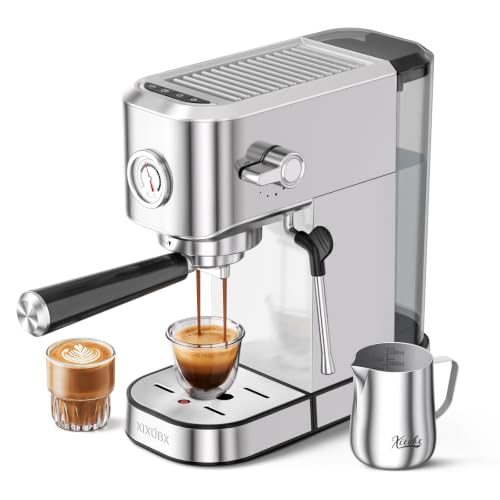
XIXUBX 20-Bar Espresso Machine — Best budget pressure-gauge option
The XIXUBX gives home users several enthusiast-style features without moving into a much more expensive machine.
It combines a 20-bar pump, built-in pressure gauge, steam wand, stainless-steel construction, and a 42-ounce removable water tank.
The visible gauge is useful for people who want more feedback while learning espresso rather than relying entirely on preset buttons.
Why it wins: It delivers the traditional pressure-gauge-and-steam-wand experience at a more accessible level than premium enthusiast machines.
Pros
- 20-bar pump
- Built-in pressure gauge
- Powerful steam wand
- 42-ounce removable water tank
- Stainless-steel construction
- Includes milk frothing pitcher
Cons
- Manual milk steaming takes practice
- Does not include a built-in grinder
Trade-offs / Who should skip: If you want the machine to handle grinding or milk preparation automatically, the Ninja or KitchenAid will require fewer separate steps.
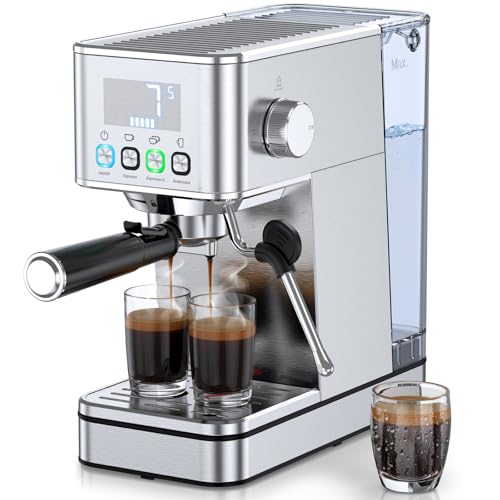
KIUADOA 20-Bar Espresso Machine — Best value for hot and cold drinks
The KIUADOA is one of the more feature-packed machines in this price range. It supports traditional espresso and milk drinks while also adding a cold-brew function.
The supplied listing includes PID temperature control, a 57.5-ounce water tank, cup warming, automatic power-off, and a cleaning mode.
That combination makes it a useful option for households that want more flexibility than a very basic espresso machine without paying for an integrated grinder or fully automatic system.
Why it wins: It combines PID temperature control, a large water tank, steam frothing, and cold-drink capability in a relatively accessible machine.
Pros
- 20-bar espresso system
- PID temperature control
- Cold-brew function
- Steam frother
- 57.5-ounce water tank
- Automatic power-off and cleaning mode
Cons
- More settings mean a slightly more involved workflow than a basic machine
- No integrated grinder
Trade-offs / Who should skip: Buyers mainly interested in straightforward espresso and cappuccinos may not need the extra cold-drink and temperature-control features.
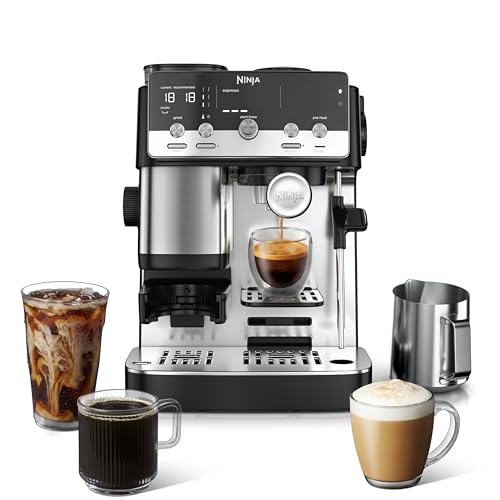
Ninja Luxe Café Mini — Best all-in-one with grinder and scale
The Ninja Luxe Café Mini is the most versatile semi-automatic-style system in the lineup for people who do not want to buy a grinder separately.
It combines espresso and drip coffee capability with a built-in burr grinder, precision scale, and manual steam wand.
That makes it especially attractive for households that drink both regular coffee and espresso-based drinks but do not want several separate appliances covering the counter.
Why it wins: The integrated grinder and scale make it a more complete coffee station than most compact espresso machines.

Pros
- Built-in burr grinder
- Integrated precision scale
- Makes espresso and drip coffee
- Manual steam wand
- Supports lattes and cappuccinos
- Reduces the need for separate coffee equipment
Cons
- Costs more than basic espresso-only machines
- More complex than a simple capsule or pump machine
Trade-offs / Who should skip: If you already own a good grinder or only drink espresso, you may be paying for features you will not use.
Nespresso Vertuo Pop+ by De’Longhi — Best for one-touch convenience
The Nespresso Vertuo Pop+ is the simplest choice here for someone who wants espresso-style drinks without measuring coffee, tamping a portafilter, or learning extraction technique.
Its compact design includes a 25-fluid-ounce side water tank, approximately 30-second heat-up, and one-touch brewing.
The main difference is that you are buying into the Vertuo capsule system rather than using ordinary ground coffee.
Why it wins: It dramatically reduces the work involved in making a quick espresso or coffee compared with traditional semi-automatic machines.

Pros
- One-touch brewing
- Compact design
- Approximately 30-second heat-up
- 25-ounce side water tank
- Minimal espresso preparation required
- Strong option for fast everyday use
Cons
- Requires compatible capsules
- Provides less hands-on control than a portafilter machine
Trade-offs / Who should skip: Skip it if experimenting with grind size, dose, extraction, and milk steaming is part of why you want an espresso machine.
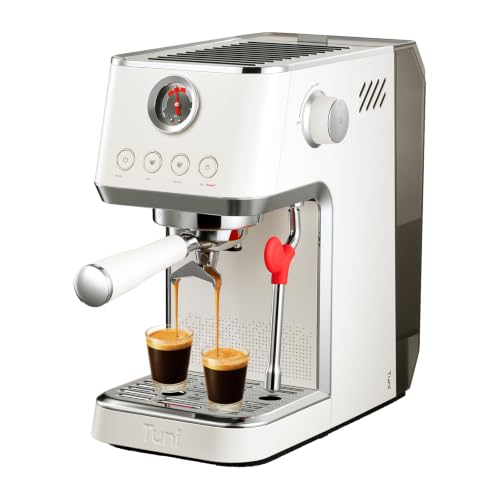
Tuni E2 Gen3 Dual Boiler Espresso Machine — Best for advanced manual control
The Tuni E2 Gen3 is the step-up choice for home users who want more control than entry-level machines provide.
Its listing specifies a dual-boiler design, 58mm brewing system, PID and NTC temperature control, 20-bar pump, and enhanced steam capability. It also supports cold-brew preparation alongside espresso, cappuccinos, and lattes.
The larger 58mm brewing platform and temperature-control features make it a more enthusiast-oriented machine than the compact budget models above.
Why it wins: It provides the most advanced traditional espresso hardware in this roundup without jumping to the extreme prices of high-end prosumer machines.
Pros
- Dual-boiler design
- 58mm brewing system
- PID and NTC temperature control
- 20-bar pump
- Enhanced steam system
- Supports hot espresso and cold-brew preparation
Cons
- More expensive than beginner machines
- More manual than fully automatic alternatives
- Smaller customer-review base than the more established picks
Trade-offs / Who should skip: Beginners who mainly want quick morning coffee will get more practical value from the Bambino Plus, Nespresso, or KitchenAid.
KitchenAid KF2 Fully Automatic Espresso Machine — Best fully automatic option
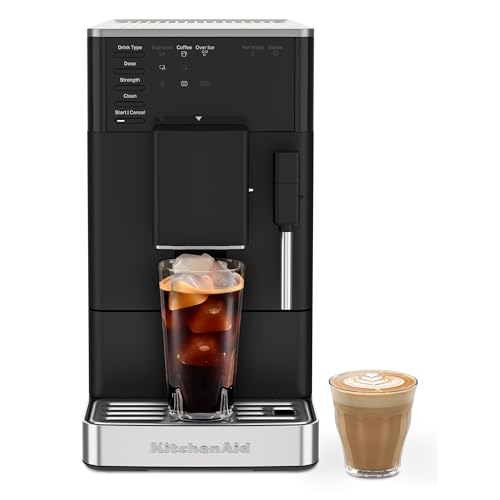
The KitchenAid KF2 is designed for buyers who want to minimize manual espresso preparation.
It combines a built-in burr grinder with fully automatic drink preparation and multiple hot and iced coffee recipes. Its Intelligrind system adjusts the grinder as part of the automatic workflow.
That makes it a very different proposition from the manual and semi-automatic machines in the roundup: convenience takes priority over learning barista technique.
Why it wins: It handles considerably more of the process automatically, from grinding beans through preparing drinks.
Pros
- Fully automatic operation
- Built-in burr grinder
- Multiple hot and iced drink options
- Intelligrind system
- Minimal hands-on espresso preparation
- Good fit for frequent everyday use
Cons
- Considerably more expensive than manual machines
- Offers less hands-on control for people who enjoy traditional espresso preparation
Trade-offs / Who should skip: If learning to dial in espresso and steam milk manually is part of the appeal, a semi-automatic machine gives you more involvement for less money.
Quick Compare
- Breville Bambino Plus: best overall beginner-friendly semi-automatic.
- XIXUBX 20-Bar: best affordable machine with a pressure gauge.
- KIUADOA 20-Bar: best value for hot espresso plus cold-drink flexibility.
- Ninja Luxe Café Mini: best all-in-one option with grinder and scale.
- Nespresso Vertuo Pop+: best for capsule-based one-touch convenience.
- Tuni E2 Gen3: best for advanced manual control and dual-boiler capability.
- KitchenAid KF2: best fully automatic bean-to-cup option.
Final Verdict
The Breville Bambino Plus remains the best starting point for most beginners because it keeps the traditional espresso workflow while making milk drinks easier.
For a less expensive manual setup, the XIXUBX gives you a pressure gauge and steam wand, while the KIUADOA adds PID temperature control and cold-drink capability.
The Ninja Luxe Café Mini is the better all-in-one choice when you also need a grinder, and the Nespresso Vertuo Pop+ is the easiest option when convenience matters more than manual control.
More advanced home baristas should consider the Tuni E2 Gen3, while the KitchenAid KF2 is the premium choice for people who want grinding and drink preparation handled automatically.
As an Amazon Associate, I earn from qualifying purchases.