
Best Crawlspace Dehumidifiers for 2026
As an Amazon Associate I earn from qualifying purchases. Some links may earn us a commission at no extra cost to you.
A crawlspace dehumidifier has to do three things well: pull real moisture (pints/day), fit low-clearance spaces, and drain reliably (gravity or pump). I focused on sealed/encapsulated crawlspaces, since that’s where these units shine.
How I researched
I compared the last 12–24 months of spec sheets/manuals and reputable retailer tech specs, prioritized AHAM pints/day (my primary metric), checked low-clearance dimensions + drain/pump options, noted discontinued/hard-to-find models, and weighed ownership factors like filtration and warranty terms—using a mobile-first affiliate layout checklist.
Top picks
Santa Fe Compact70 — Best for low-clearance crawlspaces
A compact, purpose-built unit that’s easy to hang between joists and still pulls strong moisture for sealed crawlspaces. Why it wins: small footprint + solid efficiency for its size.
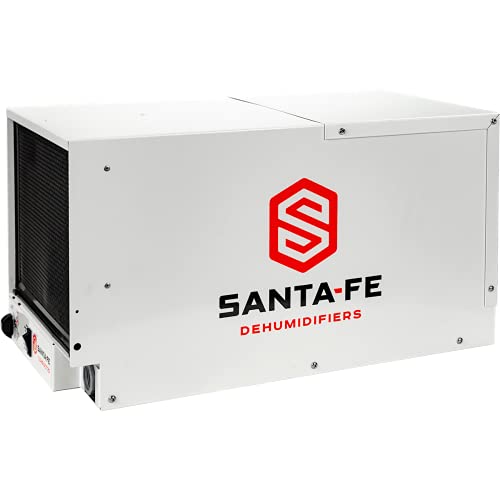
- Auto restart allows the dehumidifier to automatically restart after a power outage
- Unmatched 6-year warranty
- Engineered for low temperature operation and the air flow issues that crawl spaces present
Pros
-
70 pints/day at 80°F/60% RH (AHAM)
-
Compact: 12″ x 12″ x 21″
-
Low-ish sound spec listed at 55 dBA
-
MERV-13 filtration listed
Cons
-
No built-in pump (gravity drain only)
-
Warranty depends on manufacture date (see below)
Trade-offs / Who should skip
-
Skip if you must pump condensate uphill/long distance (choose my HDi90 pick).
-
If you’re buying older stock, note Santa Fe’s newer 6-year “Total Peace of Mind” coverage applies to units manufactured starting Jan 1, 2024; older units may follow different terms.
Scores: Performance 4.5/5 • AHAM pints/day 4/5 • Ease of use 4/5 • Value 3.5/5
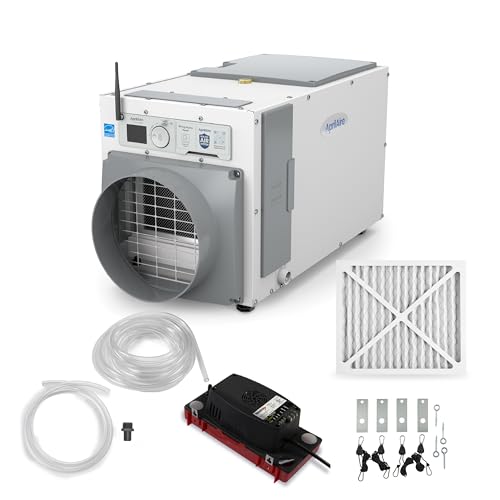
AprilAire E100 — Best for larger sealed crawlspaces
A higher-capacity, HVAC-friendly dehumidifier that works well when your crawlspace is big (or you want to tie it into ducts). Why it wins: strong AHAM capacity + widely documented specs.
Pros
-
Up to 100 pints/day moisture removal (maker spec)
-
5-year warranty (maker spec sheet)
-
Listed airflow numbers (up to 280 CFM on spec sheet)
-
Designed for basement/crawlspace/whole-home installs
Cons
-
Bigger than ultra-low-profile crawlspace units
-
No built-in pump (plan your drain route)
Trade-offs / Who should skip
-
Skip if your crawlspace regularly runs cold and you need the lowest-temp operation you can get (see DR90 spec for broader temp range).
-
If you only have a small crawlspace, this can be more machine than you need.
Scores: Performance 4.5/5 • AHAM pints/day 4.5/5 • Ease of use 4/5 • Value 3.5/5
ALORAIR Sentinel HDi90 (built-in pump) — Best when you need pumped drainage
This is the “I can’t rely on gravity” pick: built-in pump + crawlspace-ready form factor. Why it wins: 90 AHAM pints/day with a pump, so it fits tougher drain layouts.
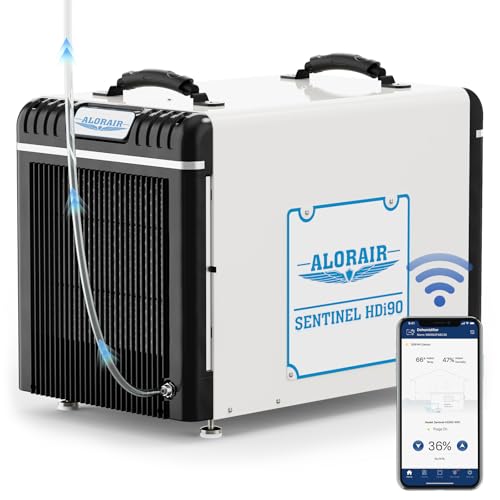
- Smart Remote Monitoring & Control - Seamlessly manage your ALORAIR 198-pint crawl space dehumidifier with the free WiFi app. Monitor real-time humidity levels, adjust settings, and track progress from anywhere, ensuring consistent performance even when you're away. Enjoy hassle-free dehumidification with remote access
- High-Efficiency Dehumidifier - This commercial-grade 198-pint unit delivers efficient moisture removal (90 pints/day AHAM, 198 pints saturation). Designed for crawl spaces, basements and large areas up to 2600 sq ft, its continuous drainage system with included hose ensures hassle-free operation, it's an effective solution for crawlspace and commercial applications
- Advanced Dehumidifier for Modern Homes - Featuring C-ETL certified safety, this heavy-duty dehumidifier delivers high-efficiency moisture control for crawl spaces and basements. Its auto-defrost system maintains operation in low temperatures, while the MERV-1 filter improves air quality. With durable construction, it's an effective solution for both crawl space and commercial applications requiring reliable humidity management

Pros
-
90 PPD @ AHAM; 198 PPD at saturation (maker listing)
-
Pump drainage (maker listing)
-
5-year limited warranty + ETL claim on maker page
-
Manual documents integral condensate pump
Cons
-
Pump adds complexity (more to maintain)
-
Larger footprint than true “micro” units
Trade-offs / Who should skip
-
Skip if you have an easy floor drain and want maximum simplicity (gravity-drain models are simpler).
-
If you’re noise-sensitive and the crawlspace is directly under a bedroom, prioritize quieter-spec’d units (Santa Fe lists 55 dBA).
Scores: Performance 4.5/5 • AHAM pints/day 4/5 • Ease of use 4/5 • Value 4/5
ALORAIR Sentinel HD55 — Best value for smaller crawlspaces
A smaller-capacity crawlspace unit that’s usually easier to justify when you don’t need 70–100 AHAM pints/day. Why it wins: right-sized moisture removal for smaller footprints.
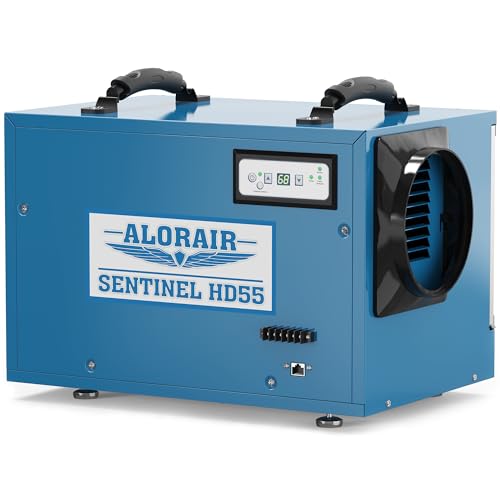
- 113 Pint Dehumidifier: AlorAir Sentinel HD55 commercial dehumidifier can remove 113 PPD at saturation, 53 pints per day at AHAM, up to 1,200 sq.ft, lowering the humidity to comfortable levels in a short period. On the other hand, this cETL-listed dehumidifier is made of a metal outer casing that withstands more rugged conditions, ensuring long-term use and easy maintenance. Fit any crawl spaces, basements, warehouses, offices, factories, shops, storage areas
- Super Convenient Usage: This high-quality dehumidifier is adjusted simply to the ideal humidity setting to minimize moisture and reduce odor. The MERV-1 Filter can protect internal components from dust when dehumidifying. The most convenient point is that you are not requested to pour away the water every hour like a typical domestic dehumidifier, there is no tank inside, it drains automatically
- Automatic Defrost: Our advanced auto-defrosting system continuously monitors the ambient temperature using built-in sensors. When the temperature is detected to be low, the unit initiates an automatic defrost cycle to prevent frost buildup and related issues. During this process, the compressor temporarily stops while the fan continues to operate, allowing the frost to thaw. Once the defrost cycle is complete, the dehumidifier resumes normal operation. This feature conserves energy and helps extend the lifespan of the unit
Pros
-
53 PPD @ AHAM; 113 PPD at saturation (maker listing)
-
Size target around 1,200 sq ft listed
-
5-year warranty stated by AlorAir support
-
Crawlspace-friendly low-profile shape
Cons
-
Gravity drain only (not a pump model)
-
Lower AHAM pints/day than my “large crawlspace” picks
Trade-offs / Who should skip
-
Skip if you’re fighting persistent dampness in a big sealed crawlspace—move up to ~70–100 AHAM pints/day.
-
If your only drain route is uphill, choose my HDi90 pick.
Scores: Performance 3.5/5 • AHAM pints/day 3/5 • Ease of use 4/5 • Value 4.5/5
Honeywell TrueDRY DR90 — Best for ventilation-ready setups (and wide temp range)
This one is built as a ventilating dehumidification system with duct connections and documented performance across temps. Why it wins: flexible ducting + specs show capacity at multiple temperature points.
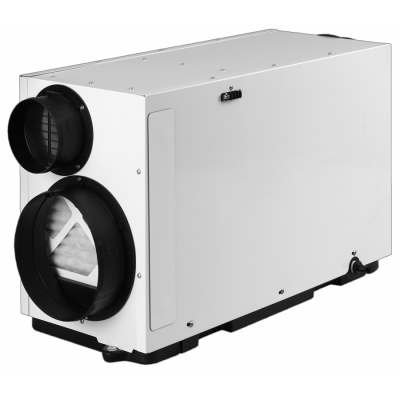
- TrueDRY DR90 Whole House Dehumidifier
Pros
-
Capacity listed at 60°F, 70°F, and 80°F (up to 90 pints/day @ 80°F/60%)
-
Wide operating temp range listed (34–135°F)
-
ETL listed + Energy Star rated (spec sheet)
-
MERV-11 filtration listed
Cons
-
Typically more “system install” than plug-and-play
-
Can be harder to find / odd listings on Amazon
Trade-offs / Who should skip
-
Skip if you want the simplest setup with a short gravity drain hose—this is more HVAC-style.
-
If you want max moisture removal per day in a sealed crawlspace, my E100/Compact70 picks are more straightforward.
Scores: Performance 4/5 • AHAM pints/day 4/5 • Ease of use 3/5 • Value 3.5/5
Quick compare
-
Lowest clearance / easiest to hang: Santa Fe Compact70
-
Large sealed crawlspace: AprilAire E100
-
Need to pump water out: ALORAIR Sentinel HDi90
-
Smaller crawlspace on a budget: ALORAIR Sentinel HD55
-
Ducted + ventilation-focused setup: Honeywell TrueDRY DR90
Buying guide (how I’d pick for a crawlspace)
-
Start with AHAM pints/day (my main metric):
-
~50–55 AHAM PPD: smaller crawlspaces (HD55 tier).
-
~70 AHAM PPD: many sealed crawlspaces (Compact70 tier).
-
~90–100 AHAM PPD: larger/tougher spaces (HDi90/E100 tier).
-
-
Drain plan: gravity to a floor drain is simplest; choose a built-in pump if you must push water uphill/long distance.
-
Check temperature range: colder crawlspaces benefit from broader operating specs.
-
Confirm clearance + service space: measure height AND leave room to pull filters and access the drain.
-
Watch warranty fine print: some brands tie coverage to manufacture date or registration—don’t assume.
FAQs
Do I need a “crawlspace-specific” dehumidifier?
If your crawlspace is tight/low-clearance or you want hanging/duct options, yes—crawlspace models are designed for that form factor and continuous drainage.
What humidity should I set it to?
Most people target a steady mid-range (often around the mid-40s to mid-50s %RH) to reduce musty conditions without overworking the unit. If you’re unsure, start higher and step down gradually.
Do I need a pump?
Only if you can’t rely on gravity drainage. If your drain is uphill, far away, or you need to lift water into plumbing, a built-in pump model is the cleanest solution.
Can I just use a regular upright “room” dehumidifier?
You can, but many aren’t ideal in crawlspaces (clearance, durability, continuous drain routing, and service access are common pain points).
Why do some specs show different pint ratings?
Manufacturers may list AHAM (80°F/60% RH) and also “saturation” ratings. Compare AHAM-to-AHAM for a fair, real-world baseline.
As an Amazon Associate, I earn from qualifying purchases.