
Best budget 4K projectors
As an Amazon Associate, I earn from qualifying purchases. Some links may earn us a commission at no extra cost to you.
Budget 4K projectors can deliver a much sharper big-screen experience without moving into premium home-theater pricing. The important distinction is that some models deliver true 4K UHD, while others use enhancement or support 4K input while projecting at a lower native resolution.
Brightness, gaming response, placement flexibility, smart streaming features, and room lighting can matter just as much as resolution. For the best picture, use a proper screen and control ambient light whenever possible.
Top Picks
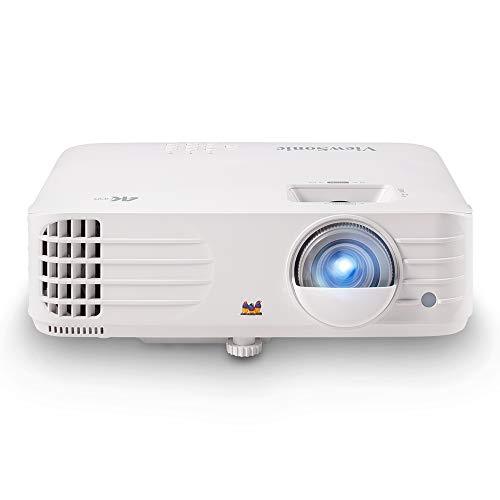
ViewSonic PX701-4K — Best Overall Budget 4K Projector
The ViewSonic PX701-4K balances 4K UHD resolution, strong brightness, HDR support, and gaming features in a projector that works well for mixed home use.
Its 3,200-lumen rating makes it more practical than dimmer projectors when you cannot completely darken the room, while its gaming-oriented refresh-rate support also gives it a role beyond movies.
Why it wins: It offers a versatile combination of 4K picture quality, useful brightness, and gaming capability without becoming overly specialized.

Pros
- 4K UHD resolution
- 3,200-lumen rating
- HDR support
- 240Hz support
- Works well for movies, sports, and gaming
Cons
- Black levels are not as deep as higher-end cinema projectors
- Built-in speakers are fairly basic
Trade-offs / Who should skip: Home-theater enthusiasts prioritizing deep blacks over brightness may want a more cinema-focused projector. Gamers needing even more brightness should also consider the Optoma UHD38x.
Optoma UHD38x — Best for Gaming
The Optoma UHD38x is built around bright 4K entertainment and responsive gaming.
Its listing specifies true 4K UHD, 4,000 lumens, HDR10 and HLG support, a 240Hz refresh rate, and a 4.2ms response time at 1080p in its enhanced gaming mode.
Why it wins: Its combination of high brightness and gaming-focused response makes it the clearest choice here for console and PC gaming.

Pros
- True 4K UHD
- 4,000-lumen rating
- 240Hz refresh support
- 4.2ms listed response time at 1080p
- HDR10 and HLG support
Cons
- Dark-room black levels are not its main strength
- Placement flexibility is limited compared with models offering lens shift
Trade-offs / Who should skip: Buyers building a dedicated dark-room theater may prioritize contrast over the UHD38x’s brightness and gaming performance.
Epson Home Cinema 2350 — Best for Flexible Placement
The Epson Home Cinema 2350 is a good fit for living rooms where projector placement is not perfectly centered or fixed.
It combines Epson’s 3LCD technology with 4K PRO-UHD processing, 2,800 lumens of color and white brightness, and vertical lens shift. Android TV also provides built-in smart streaming functionality.
Why it wins: Vertical lens shift gives it more practical setup flexibility than many budget projectors.

Pros
- 4K PRO-UHD processing
- 2,800 lumens of color and white brightness
- 3-chip 3LCD design
- Vertical lens shift
- Android TV included
Cons
- Uses 4K enhancement rather than native 4K panels
- Larger than compact smart projectors
Trade-offs / Who should skip: Buyers mainly interested in a small plug-and-play projector may prefer the JMGO N1S or one of the lower-cost smart models.
ViewSonic PX749-4K — Best for Bright Rooms
The ViewSonic PX749-4K is the stronger option for sports, gaming, and home entertainment in rooms where some ambient light is unavoidable.
Its 4,000-lumen rating gives it an advantage over dimmer compact projectors, while its 4K UHD, HDR/HLG support, and gaming features make it versatile enough for mixed use.
Why it wins: High brightness makes it the most useful choice here when lights-on viewing matters.

Pros
- 4K UHD
- 4,000-lumen rating
- HDR and HLG support
- Gaming-oriented features
- Good fit for sports and mixed entertainment
Cons
- Brightness-focused performance does not guarantee the deepest black levels
- Limited lens-shift flexibility
Trade-offs / Who should skip: If you mostly watch movies in a dark room and care more about convenient smart features than raw brightness, the JMGO or Epson may be a better fit.
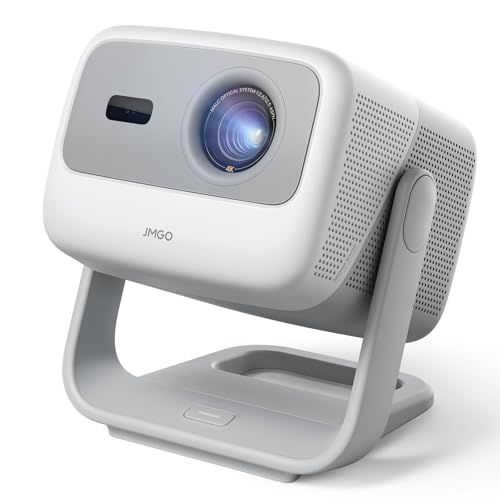
JMGO N1S 4K Upgrade Triple Laser Projector — Best Compact Laser Smart Projector
The JMGO N1S 4K Upgrade fills the compact smart-projector role with a triple-laser design and an integrated gimbal that makes positioning easier.
Its supplied listing specifies 1,700 ISO lumens, Google TV with Netflix, gimbal autofocus, HDR10, Wi-Fi 6, Dolby Audio, 3D support, and support for images up to 200 inches.
Why it wins: It combines a more premium triple-laser design with smart streaming and flexible gimbal-based setup in a relatively compact all-in-one format.
Pros
- Triple-laser projector design
- 1,700 ISO lumens
- Google TV and Netflix
- Gimbal autofocus
- HDR10 and Dolby Audio
Cons
- Costs more than the entry-level smart projectors
- Not as bright as the 4,000-lumen ViewSonic and Optoma models
Trade-offs / Who should skip: Choose this for smart features, laser projection, and setup convenience. Buyers primarily concerned with maximum brightness for lights-on viewing should choose the PX749-4K or UHD38x instead.
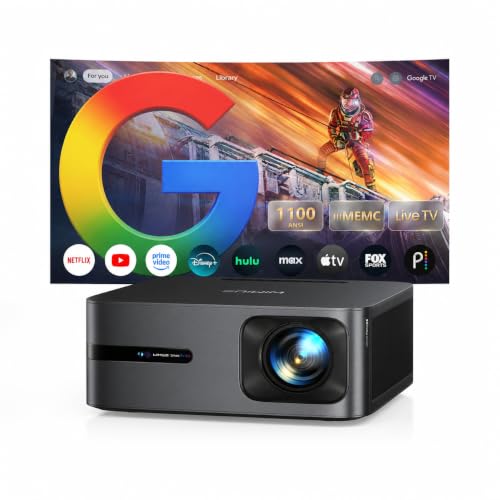
WiMiUS G2 Google TV Projector — Best Affordable Google TV Pick
The WiMiUS G2 targets buyers who want a low-cost all-in-one streaming projector rather than premium true-4K hardware.
It supports 4K input and includes Google TV, Wi-Fi 6, Bluetooth, autofocus, auto keystone, HDR10, MEMC motion processing, and built-in Dolby audio.
Why it wins: It packs a wide range of smart and automatic setup features into a much more affordable projector.
Pros
- Google TV built in
- 4K input support
- Autofocus and auto keystone
- Wi-Fi 6 and Bluetooth
- HDR10 and MEMC support
Cons
- Not equivalent to a premium native 4K projector
- Better suited to casual viewing than serious home-theater use
Trade-offs / Who should skip: Buyers specifically looking for higher-end 4K image performance should stay with the ViewSonic, Optoma, Epson, or JMGO options.
TOPTRO A2 Smart Projector — Best Low-Cost Smart Projector
The TOPTRO A2 is another convenience-first option for buyers who prioritize built-in entertainment features and simple setup.
Its supplied listing includes the VIDAA smart platform, live TV access, voice control, 36W Dolby audio, Wi-Fi 6, Bluetooth, autofocus, HDR10, and a short-throw-friendly design.
Why it wins: It offers a broad selection of smart and setup features for buyers trying to keep projector costs down.
![Smart Projector 4K [VIDAA Live TV & 36W Dolby & Voice Control] with WiFi6 and Bluetooth, Short Throw Projector Compatible with Netflix, AI Auto Focus, HDR10, Home Theater Proyector for Outdoor Movies](https://m.media-amazon.com/images/I/51LPK2IYH0L.jpg)
Pros
- Built-in VIDAA smart platform
- Voice control
- Wi-Fi 6 and Bluetooth
- Autofocus
- 36W Dolby audio
Cons
- Less established than major projector brands
- Best results still require controlled lighting
Trade-offs / Who should skip: Buyers who care more about proven projector performance than smart features should spend more on the ViewSonic, Optoma, Epson, or JMGO models.
Quick Compare
- ViewSonic PX701-4K: best overall budget 4K projector.
- Optoma UHD38x: best for gaming.
- Epson Home Cinema 2350: best for flexible placement.
- ViewSonic PX749-4K: best for bright rooms and sports.
- JMGO N1S 4K Upgrade: best compact laser smart projector.
- WiMiUS G2: best affordable Google TV option.
- TOPTRO A2: best low-cost smart projector.
Final Verdict
The ViewSonic PX701-4K remains the strongest all-around option for buyers who want a versatile 4K projector for movies, gaming, and everyday entertainment.
Choose the Optoma UHD38x for gaming, the Epson Home Cinema 2350 when placement flexibility matters, or the ViewSonic PX749-4K when brightness is the priority.
For buyers who prefer a compact all-in-one smart setup, the JMGO N1S 4K Upgrade offers triple-laser projection, Google TV, and gimbal-based positioning. The WiMiUS G2 and TOPTRO A2 are better suited to shoppers prioritizing affordable streaming convenience over premium 4K performance.
As an Amazon Associate, I earn from qualifying purchases.