
Best Studio Headphones and Which Ones Need an Amplifier
As an Amazon Associate I earn from qualifying purchases. Some links may earn us a commission at no extra cost to you.
Studio is not a protected word, so plenty of consumer headphones wear it. The genuine article is tuned flat rather than flattering, because the point is to hear what is actually in the recording, including the parts you would rather not hear. Two decisions matter more than the badge. Closed back seals against your head and keeps sound in, which is what you need while recording next to a microphone; open back lets air through, sounds more spacious and leaks audibly into the room, which suits mixing and ruins tracking. The other is impedance. A 250 ohm pair plugged into a phone plays quietly and thinly, and people blame the headphones rather than the missing amplifier. I score these on monitoring accuracy and say plainly which need more power than a laptop provides.
Top picks
Sony MDR-7506 — Best overall


Why it wins: The pair you will find in more edit suites, broadcast trucks and radio studios than anything else, still in production decades after release, and still the cheapest serious option in most studios. Closed back with 63 ohm impedance, which a laptop or interface drives without complaint, and a slightly forward upper midrange that makes flaws easy to hear.
Pros
- The de facto industry reference for spoken word and tracking
- Low enough impedance to run from any interface or laptop
- Parts and replacement pads are widely available after all these years
- Folds flat with a carry pouch
Cons
- The coiled cable is fixed rather than detachable
- Pads are famously prone to flaking after a few years
- Slightly bright, so long sessions can tire you
Social proof: See rating and reviews on Amazon.
Trade-offs and who should skip: Analytical rather than pleasant, which is the job. Skip it if you want headphones for enjoying music. Skip it if a non-removable cable is a dealbreaker.
Scores: Performance 5/5 | Monitoring accuracy 5/5 | Ease of use 5/5 | Value 5/5
Audio-Technica ATH-M50x — Best all-rounder

Why it wins: The most reviewed pair in the category by a wide margin, closed back, with detachable cables and a build that survives being thrown in a bag. Worth being straight about the tuning: it carries more low end lift than a strictly flat reference would, which is exactly why it crossed over into everyday listening.
Pros
- Enormous review base and a long track record
- Three detachable cables included
- 90 degree swivelling cups for one-ear monitoring
- Comfortable enough for long sessions
Cons
- Bass is lifted rather than flat, despite the monitor branding
- Clamping force is tight until the pads break in
- Mixes made on a bass-lifted pair tend to end up bass-light elsewhere
Social proof: See rating and reviews on Amazon.
Trade-offs and who should skip: A very good pair of headphones and not a neutral reference. Skip it if you are mixing low end and nothing else. Skip it if you want the flattest response available at the price.
Scores: Performance 4/5 | Monitoring accuracy 3/5 | Ease of use 5/5 | Value 4/5
beyerdynamic DT 990 Pro 250 Ohm — Best for mixing, and read the impedance
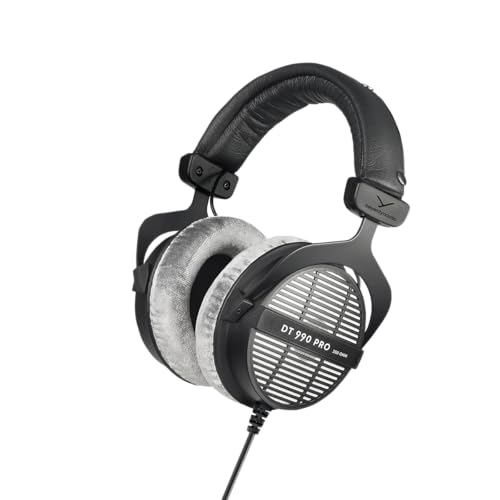
Why it wins: Open back, which gives a sense of space and depth that closed designs cannot, and makes long mixing sessions far less fatiguing because your ears are not sealed in. This is the pair for judging reverb and stereo width. The 250 ohm version genuinely needs a headphone amp or an audio interface, and the listing says so.
Pros
- Open back gives the most spacious presentation here
- Velour pads stay comfortable over hours
- Excellent for judging depth and stereo placement
Cons
- 250 ohms is too much for a phone or most laptops to drive properly
- Open back leaks sound badly, so useless for recording near a microphone
- Everyone nearby hears what you are listening to
- Treble is lifted, which suits detail hunting and tires some listeners
Social proof: See rating and reviews on Amazon.
Trade-offs and who should skip: The best listening experience here and the least portable use case. Skip it if you have no amplifier or interface. Skip it if you record with a live microphone in the room.
Scores: Performance 5/5 | Monitoring accuracy 5/5 | Ease of use 2/5 | Value 4/5
Sennheiser HD 280 Pro — Best isolation for recording

Why it wins: Sennheiser quotes 32dB of attenuation, which is the specification that matters when a microphone is live in the same room. Headphone spill into a vocal take is a problem you cannot fix afterwards, and this seals tighter than anything else here.
Pros
- Highest quoted isolation on this page
- Keeps monitoring out of the microphone during takes
- Coiled cable suits moving around a desk
- Folds compactly
Cons
- Clamping force is high, which is how the isolation works and why it aches
- Sound is unexciting compared with the others
- Cable is not detachable
Social proof: See rating and reviews on Amazon.
Trade-offs and who should skip: Isolation comes from pressure on your head. Skip it if you wear glasses and dislike clamping. Skip it if you want headphones for listening rather than for tracking.
Scores: Performance 4/5 | Monitoring accuracy 4/5 | Ease of use 3/5 | Value 5/5
AKG K92 — Best budget entry

Why it wins: Closed back monitoring from a genuine pro audio brand, the least costly option here, with self-adjusting headband so there is nothing to set up. For a first interface and a bedroom setup, it does the job that matters: letting you hear roughly what is there without lying to you badly.
Pros
- Cheapest genuine studio design on this page
- Closed back, so usable for recording
- Easy to drive from any source
Cons
- Build is plastic and feels it
- Less detailed than the pairs above
- Cable is fixed
Social proof: See rating and reviews on Amazon.
Trade-offs and who should skip: Honest sound on a budget build. Skip it if the headphones will be moved and handled daily. Skip it if you are mixing work other people will pay for.
Scores: Performance 3/5 | Monitoring accuracy 4/5 | Ease of use 5/5 | Value 5/5
Quick compare
- Best overall: Sony MDR-7506, fixed cable and flaking pads
- Best all-rounder: Audio-Technica ATH-M50x, bass lifted rather than flat
- Best for mixing: beyerdynamic DT 990 Pro, needs an amplifier and leaks sound
- Best for tracking: Sennheiser HD 280 Pro, tight clamp
- Best budget: AKG K92, plastic build
If you take one thing from this page, take the impedance rule. Anything above about 100 ohms wants a headphone amplifier or an audio interface, not a phone, and a high impedance pair driven from a weak output will sound quiet and lifeless in a way that is entirely the fault of the source. Check the ohm figure before you buy, because the same model is often sold in several versions and the listings do not always make the difference obvious.
As an Amazon Associate, I earn from qualifying purchases.