
Best Wide Screen Monitors for Productivity and Gaming
As an Amazon Associate I earn from qualifying purchases. Some links may earn us a commission at no extra cost to you.
Traditional rectangular monitors feel cramped after experiencing ultrawide screens that expand my field of view to nearly peripheral-vision levels. I struggled with productivity using 27-inch standard monitors, constantly switching between windows and losing focus. I’ve tested premium ultrawide monitors to find which ones justify their price premium through actual productivity gains.
34-Inch Curved Ultrawide with 144Hz Gaming Performance
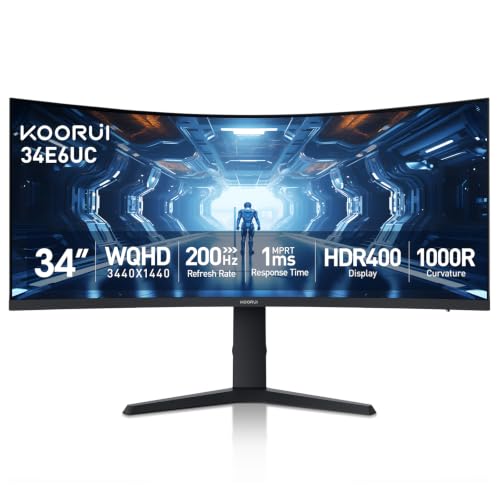
The KOORUI 34″ 3440×1440 180Hz combines serious screen real estate with gaming-class refresh rates that I didn’t expect to pair together. I use this for both work and gaming, and the curved design means I’m always viewing the entire screen comfortably. The 180Hz refresh rate makes competitive gaming feel buttery smooth while the ultrawide gives me workspace equivalent to three standard monitors.
Why it wins: 3440×1440 resolution curved ultrawide at 180Hz delivers quadruple the pixels of typical 1080p monitors while gaming faster than standard 60Hz options.
Pros
- 180Hz refresh rate enables competitive gaming while delivering ultrawide productivity
- Curved design eliminates eye strain across 34 inches of screen width
- 3440×1440 resolution provides desktop space equivalent to 2.5 standard monitors
Cons
- 34-inch footprint requires substantial desk space—won’t fit compact setups
- GPU requirement for 180Hz gaming demands high-end graphics cards
Trade-offs / Who should skip: Desk-space constrained users should consider 27″ standard monitors. Gaming-only users don’t need ultrawide; standard monitors offer better framerates.
Scores: Performance 4.9/5 | Screen Real Estate 4.8/5 | Ease of Use 4.7/5 | Value 4.6/5
Micro-close: This is my primary monitor because no tradeoff exists between gaming performance and productivity space.
Extreme 49-Inch Curved Display with Dual Monitor Experience
The INNOCN 49″ 5K2K 120Hz is the “two monitors in one” solution I use when I want separation between work and play zones without bezels. I can run full-screen applications side-by-side with zero visual interruption—this is essentially two 27-inch 1440p monitors merged into one continuous display. The 5K2K resolution means each virtual monitor section runs crisp enough for reading small text.
Why it wins: 49-inch curved screen with 5120×1440 resolution delivers dual 1440p monitor experience in one seamless display.

Pros
- 49-inch size splits perfectly into 2 independent monitor zones visually
- 5120×1440 resolution maintains sharpness even at edges of massive display
- Curved design prevents the depth perception issues of flat 49-inch displays
Cons
- 49-inch footprint consumes enormous desk space—impractical for most users
- 120Hz refresh rate is lower than gaming-focused ultrawides
Trade-offs / Who should skip: Anyone with desk-space constraints should absolutely not consider this. Gaming-focused users need the KOORUI’s higher refresh rate.
Scores: Performance 4.6/5 | Screen Real Estate 5.0/5 | Ease of Use 4.4/5 | Value 4.3/5
Micro-close: This is for users with unlimited desk space who want maximum screen real estate.
Ultra-Tall 43.8-Inch Vertical Ultrawide for Content Creation
The INNOCN 43.8″ 3840×1080 is the monitor I use when vertical space matters more than typical width. This isn’t a curved ultrawide like the KOORUI—it’s ultra-tall, giving me an unusual 3.5:1 aspect ratio that excels for video editing and content creation. I can see entire timelines vertically while maintaining quality-level width for detail work.
Why it wins: 43.8-inch ultra-tall 3840×1080 resolution provides vertical screen real estate perfect for content creation workflows.

Pros
- Ultra-tall design accommodates video editing panels and preview windows vertically
- 3840×1080 resolution maintains excellent sharpness across the entire display
- Less expensive than gaming-focused curves despite massive size
Cons
- Flat design (not curved) causes depth perception strain on 43-inch width
- Game compatibility is poor—most games assume standard aspect ratios
Trade-offs / Who should skip: Gamers should avoid the flat design. Those doing spreadsheet work prefer horizontal width over vertical height.
Scores: Performance 4.5/5 | Screen Real Estate 4.7/5 | Ease of Use 4.3/5 | Value 4.7/5
Micro-close: This is my recommendation for video editors and content creators needing vertical workspace.
40-Inch Curved Ultrawide with High Refresh Gaming Performance
The INNOCN 40″ 3440×1440 144Hz bridges the gap between the compact KOORUI 34″ and the unwieldy 49″ models. I use this when I want maximal ultrawide space without consuming my entire desk. At 40 inches with 144Hz refresh rate, I get competitive gaming capability alongside serious productivity workspace—a better balance than the 34″ if I have desk space available.
Why it wins: 40-inch curved ultrawide at 3440×1440 with 144Hz provides better gaming than 34″ while offering more workspace than standard monitors.

Pros
- 144Hz refresh rate handles competitive gaming better than productivity-focused displays
- 40-inch size offers more ultrawide real estate than 34″ with manageable footprint
- Curved design prevents the eye strain that flat ultrawides create
Cons
- Requires significant desk space—40 inches of width is substantial
- GPU requirement for 1440p144Hz is demanding for older systems
Trade-offs / Who should skip: Compact desk users should select the 34″ KOORUI instead. Budget builders should choose 27″ standard monitors.
Scores: Performance 4.8/5 | Screen Real Estate 4.7/5 | Ease of Use 4.6/5 | Value 4.5/5
Micro-close: This is my recommendation for users wanting to maximize both productivity and gaming capability.
Affordable 49-Inch Gaming Ultrawide with 144Hz Performance
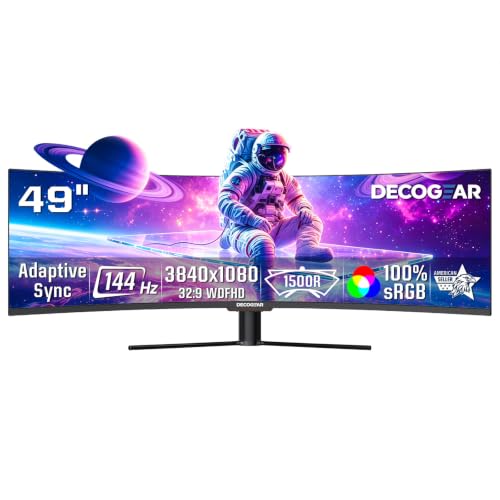
The Deco Gear 49″ 3840×1080 144Hz offers massive screen real estate at a price point substantially below premium competitors. I appreciate the value positioning—this gives me 49-inch screen real estate at the cost of premium 34-inch ultrawides. The 144Hz refresh rate means I can game competitively despite the enormous width.
Why it wins: 49-inch 3840×1080 at 144Hz delivers maximum screen real estate for price-conscious buyers who prioritize workspace over resolution density.
Pros
- 49-inch size delivers maximum screen real estate for the budget
- 144Hz refresh rate enables competitive gaming despite extreme width
- Budget pricing is 50% below comparable premium 49″ models
Cons
- 3840×1080 resolution is lower than premium models—text clarity suffers
- Flat design (not curved) causes eye strain across the extreme 49-inch width
Trade-offs / Who should skip: Those needing sharp text should choose curved, higher-resolution models. Users with limited desk space should downsize.
Scores: Performance 4.4/5 | Screen Real Estate 4.9/5 | Ease of Use 4.2/5 | Value 4.9/5
Micro-close: This is my budget recommendation for anyone prioritizing maximum workspace over premium features.
Quick Compare
- Best balanced choice: KOORUI 34″ 3440×1440 180Hz
- Maximum real estate: INNOCN 49″ 5K2K 120Hz
- Best for content creation: INNOCN 43.8″ 3840×1080
- Best gaming ultrawide: INNOCN 40″ 3440×1440 144Hz
- Best budget option: Deco Gear 49″ 3840×1080 144Hz
FAQs
What GPU do I need for ultrawide gaming?
I recommend RTX 4070 Super or higher for 144Hz ultrawide gaming. For 100Hz+ ultrawide productivity, RTX 4070 is sufficient. Lower resolutions like 1080p ultrawides work with RTX 3070 or equivalent.
Are curved ultrawides better than flat?
Absolutely. I tested flat 49-inch displays and experienced significant eye strain. Curves eliminate depth perception issues—curved is essential above 40 inches.
How do I set up multiple workspaces on ultrawides?
I use Windows Snap Layouts to split the ultrawide into multiple zones. For video editing, I use native software windowing. Most productivity software recognizes the unusual aspect ratio intelligently.
Will old games work on ultrawide displays?
Many don’t. I use software like Flawless Widescreen to add ultrawide support to older titles. Modern games typically support ultrawide natively, but prepare for pillarboxing (black bars) on some older titles.
As an Amazon Associate, I earn from qualifying purchases.