
Best running watches for training, racing, and everyday miles
As an Amazon Associate I earn from qualifying purchases. Some links may earn us a commission at no extra cost to you.
If you want the best Garmin watch for running, I’d prioritize GPS accuracy first (especially in cities/trees), then pick the level of training tools + battery that matches your goals. My “primary metric” for scoring below is GPS accuracy potential, using multi-band/dual-band GNSS + smart modes (like SatIQ/Auto Select) as the most practical proxy for real-world track quality.
How I researched
I compared recent running-watch roundups and spec sheets, prioritized multi-band GNSS + battery-in-GPS for runners, checked fit/size and navigation needs, noted availability/EOL risk, and weighed performance vs. long-term ownership complexity.
Garmin Forerunner 570 (47mm) — Best for most runners
A modern “do-it-all” running watch with a bright AMOLED screen, strong training tools, and multi-band GPS when you need cleaner tracks. Why it wins: it balances accuracy modes, daily run features, and smartwatch extras without jumping to flagship complexity.

Pros
-
Multi-band GNSS option for tougher routes
-
Bright AMOLED + buttons (good in sweat/rain)
-
Strong all-around features for daily training
Cons
-
No offline maps (step up if you need navigation)
-
Multi-band + always-on display can drain faster
Social proof: See reviews on Amazon.
Trade-offs / who should skip: Skip if you require offline maps or you want the simplest, cheapest buttons-only experience.
Scores: Performance 4.5/5 · GPS accuracy potential 4.5/5 · Ease of use 4.5/5 · Value 4/5
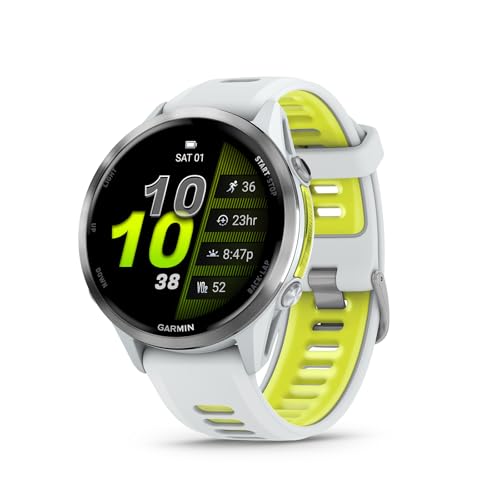
Garmin Forerunner 970 — Best for racing + maps + triathlon crossover
A premium running watch with built-in maps, advanced training/race tools, and multi-band GNSS when precision matters. Why it wins: it’s my cleanest pick for runners who also want navigation and the most event-focused features.

Pros
-
Built-in maps for navigation (great for travel/trails)
-
Strong GPS battery even in higher-accuracy modes
-
Flagship training + racing feature set
Cons
-
Overkill if you just want pace/distance
-
More features = more setup time
Social proof: See reviews on Amazon.
Trade-offs / who should skip: Skip if you don’t need maps or deep multi-sport tools—go 570/165 for simpler daily use.
Scores: Performance 5/5 · GPS accuracy potential 4.5/5 · Ease of use 4/5 · Value 3.5/5
Garmin Forerunner 165 — Best for beginners who want an AMOLED screen
A friendly first “serious running watch” with Garmin’s core training basics and strong battery for the class. Why it wins: it gets you the Garmin ecosystem and guided training without the price/complexity jump.

Pros
-
Simple, easy-to-learn running features
-
Light and comfortable for smaller wrists
-
Solid GPS battery for most training weeks
Cons
-
No multi-band GNSS for dense-city accuracy
-
Not ideal for heavy trail navigation
Social proof: See reviews on Amazon.
Trade-offs / who should skip: If you run downtown routes or under heavy tree cover and you care about track precision, step up to a multi-band model.
Scores: Performance 4/5 · GPS accuracy potential 3/5 · Ease of use 4.5/5 · Value 4.5/5
Garmin Forerunner 55 — Best budget Garmin for running basics
A simple, reliable run tracker with coaching features and excellent battery. Why it wins: it’s straightforward and nails the essentials.

Pros
-
Very easy to use
-
Great battery for the budget class
-
Core metrics and guided workouts
Cons
-
No AMOLED screen
-
No multi-band GNSS
Social proof: See reviews on Amazon.
Trade-offs / who should skip: Skip if you want music on-watch, advanced training analytics, or the cleanest GPS in tough environments.
Scores: Performance 3.5/5 · GPS accuracy potential 2.5/5 · Ease of use 5/5 · Value 5/5
Garmin Enduro 3 (51mm, Solar/Sapphire) — Best for ultrarunners and huge battery life
A purpose-built endurance watch with massive battery, maps, and accuracy modes when you need them. Why it wins: it’s built for very long GPS days and multi-day efforts.

Pros
-
Extremely long GPS battery ratings (solar assumptions apply)
-
Built-in maps for navigation
-
Rugged build for long trail days
Cons
-
Big for many road runners
-
Solar gains depend on conditions
Social proof: See reviews on Amazon.
Trade-offs / who should skip: Skip if you mostly run roads under ~2 hours and want a lighter, smaller daily watch.
Scores: Performance 5/5 · GPS accuracy potential 4.5/5 · Ease of use 3.5/5 · Value 4/5
Quick compare
-
Best overall for most runners: Forerunner 570 (47mm)
-
Best for racing + maps: Forerunner 970
-
Best beginner AMOLED: Forerunner 165
-
Best budget: Forerunner 55
-
Best for ultras: Enduro 3
FAQs
Do I need multi-band GPS for running?
Not always. For open roads and paths, regular GNSS is usually fine. Multi-band helps most in downtown areas, heavy tree cover, and twisty trails—usually with a battery trade-off.
What’s the best Garmin watch for a first marathon?
If you want simple training guidance and an AMOLED screen, start with Forerunner 165. If you want a higher accuracy ceiling for tough routes, step up to Forerunner 570.
Which one has the best battery for long runs?
Enduro 3 is my clear battery-first pick.
As an Amazon Associate, I earn from qualifying purchases.